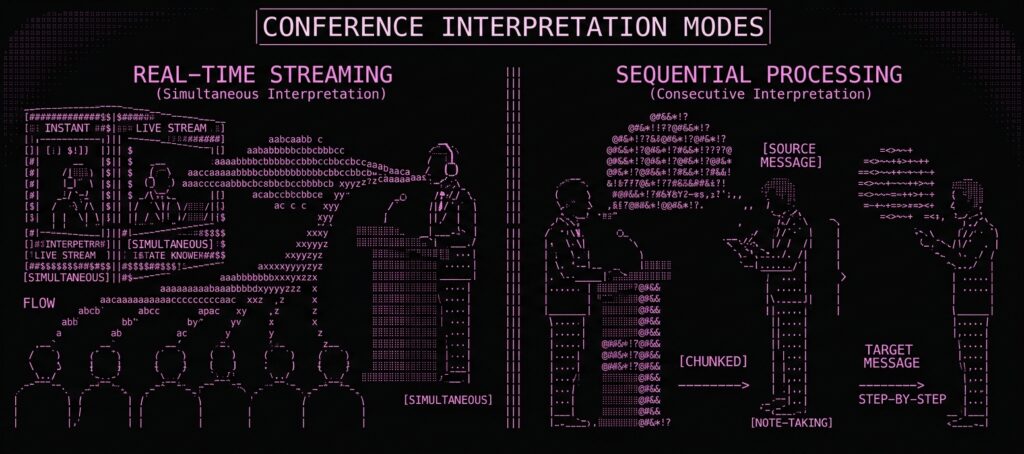
Picking the wrong interpretation mode can double your event budget or leave half your audience disengaged. Simultaneous interpretation delivers real-time translation through headsets while the speaker talks; consecutive interpretation has the speaker pause every few sentences so the interpreter can relay the message. This page gives you the tables, cost math, and decision criteria to choose correctly the first time.
Quick Comparison: Simultaneous vs Consecutive Across 10 Dimensions
| Dimension | Simultaneous | Consecutive |
|---|---|---|
| Speed | Real-time (2-5 second delay) | Doubles the session length (speaker pauses for interpreter) |
| Accuracy | 90-95% meaning capture; minor omissions under speed pressure | 95-99% meaning capture; interpreter has time to consult notes |
| Cost per interpreter per day | $1,200-$2,500 (requires 2 per language) | $700-$1,500 (often 1 per language for short sessions) |
| Equipment required | Soundproof booth, headsets, receivers, transmitters, technician | Notepad and pen. Microphone optional |
| Max languages at once | 6+ (one booth per language; relay for rare pairs) | 1-2 practical maximum |
| Ideal audience size | 50-10,000+ | 2-50 |
| Setup time | 2-4 hours (booth installation, sound checks) | 5 minutes (brief the interpreter) |
| Interpreter fatigue | High: 20-30 minute rotation required (AIIC standard) | Moderate: natural breaks built into speaker pauses |
| Best for | Keynotes, plenary sessions, large multilingual conferences | Depositions, negotiations, small workshops, press conferences |
| Worst for | Intimate 1-on-1 conversations, budget-constrained small meetings | Large audiences, multi-language events, time-sensitive programs |
When to Use Which: Decision Table by Event Type
| Event Format | Recommended Mode | Why |
|---|---|---|
| Keynote / plenary (100+ attendees) | Simultaneous | Audience cannot tolerate doubled session length |
| Breakout session (20-50 attendees) | Either, depends on language count | 1 language: consecutive saves cost. 2+: simultaneous |
| Panel discussion | Simultaneous | Multiple speakers make consecutive pauses chaotic |
| Workshop / training | Consecutive | Participants need time to process and practice; pauses help |
| Press conference | Consecutive | Standard protocol; journalists expect the pause-and-interpret format |
| Legal deposition | Consecutive | Courts require verbatim record; interpreter consults notes for precision |
| Medical consultation | Consecutive | Accuracy is life-critical; the slower mode reduces errors |
| Diplomatic negotiation | Consecutive | Each party reviews the interpreted version before responding |
| Gala dinner / awards | Simultaneous (whispered or headset) | Ceremony flow cannot be interrupted |
| Trade show booth tour | Consecutive | Small group, no equipment, high mobility |
| Multi-day conference (3+ languages) | Simultaneous | Only scalable option for multilingual programs |
| Board meeting (2 languages) | Consecutive | Small group, high-stakes accuracy, no equipment budget |
| Hybrid event (in-person + remote) | Simultaneous (RSI platform) | Remote attendees need real-time audio channel |
| Webinar (100+ virtual attendees) | Simultaneous (RSI) | Consecutive interpretation in a webinar causes mass drop-off |
The one-sentence rule: If your audience is over 50 people or you need 3+ languages, simultaneous is the only practical choice. If accuracy matters more than speed and the group is small, consecutive wins.
Cost Comparison: Same Event, Both Modes
Scenario: A 1-day corporate conference, 200 attendees, English-to-Spanish and English-to-Mandarin interpretation needed.
Simultaneous Interpretation Costs
- 4 interpreters (2 per language, AIIC standard): $7,200
- 2 soundproof booths (1 per language): $3,000
- 200 receiver units: $1,600
- Audio technician: $800
- Transmitter and headset system: $600
Total: $13,200
Event duration: 8 hours (as scheduled)
Consecutive Interpretation Costs
- 2 interpreters (1 per language): $2,200
- Equipment: $0
- Venue overtime (event runs 60-80% longer): $2,000+
- Speaker fees for extended time: $1,000+ (estimate)
- Catering extension (200 pax): $3,000
- Attendee productivity loss (8 hrs to 14 hrs): Incalculable
Total: $8,200+ direct costs
Event duration: 13-14 hours (unsustainable)
The Real Math
| Simultaneous | Consecutive | |
|---|---|---|
| Direct interpretation cost | $13,200 | $2,200 |
| Venue/logistics overage | $0 | $6,000+ |
| Total event cost impact | $13,200 | $8,200+ |
| Event duration | 8 hours | 13-14 hours |
| Attendee experience | Seamless | Disruptive |
Verdict: Simultaneous costs more upfront, but the event runs on schedule. Consecutive looks cheaper on paper, but hidden costs and an unsustainable 13-14 hour runtime make it impractical for 200 people.
For events with fewer than 30 attendees and a single language pair, consecutive typically costs $2,000-$4,000 total with no hidden costs, making it the clear budget winner for small-format events.
Equipment Requirements Table
Key insight: Simultaneous interpretation requires 7+ pieces of specialized equipment and a trained technician. Consecutive interpretation requires a notepad and a pen. This equipment gap is the single biggest reason AI-powered platforms are disrupting simultaneous interpretation first.
| Equipment | Simultaneous | Consecutive | Notes |
|---|---|---|---|
| Soundproof interpretation booth | Required | Not needed | ISO 2603 (fixed) or ISO 4043 (mobile). Min 2.4m x 2.4m x 2.3m per booth |
| Interpreter console with channel selector | Required | Not needed | Must support relay mode and booth-mate monitoring |
| Wireless receiver units | Required (1 per attendee) | Not needed | Infrared (IR) or FM radio frequency |
| Headsets for attendees | Required | Not needed | Disposable or reusable; budget $3-$8 per unit |
| Microphone (speaker) | Required | Recommended | Lapel or podium mic feeds directly to interpreter booth |
| Microphone (interpreter) | Required (in booth) | Optional | Gooseneck mic built into console |
| Audio technician on-site | Required | Not needed | Manages channels, troubleshoots feedback, monitors levels |
| Notepad and pen | Optional | Required | Consecutive interpreters use a specialized symbol-based note-taking system |
| Backup interpreter | Required (already built into the team of 2) | Recommended for sessions over 2 hours | AIIC mandates 2 interpreters per booth for simultaneous |
| RSI platform (for virtual/hybrid) | Required for remote delivery | Not standard | Platforms: Interprefy, Kudo, Zoom RSI |
| Booth ventilation system | Required | N/A | ISO standard: air renewal 7x per hour, noise below 35 dB |
The AI Angle: How Technology Is Changing Both Modes
Most AI interpretation platforms only handle simultaneous mode. They process audio in real-time and output translated text or speech with minimal delay. This works well for scale but comes with trade-offs.
| Capability | Human Simultaneous | Human Consecutive | AI Platforms |
|---|---|---|---|
| Real-time delivery | Yes (2-5 sec delay) | No (30-120 sec delay) | Yes (1-3 sec delay) |
| Handles idioms and cultural nuance | Excellent | Excellent | Improving but inconsistent |
| Available in 75+ languages | No (interpreter pool limits) | No (same limitation) | Yes (Snapsight supports 75+) |
| Cost per session | $3,000-$7,000+ | $700-$1,500 | $0 incremental (platform fee covers it) |
| Scales to 6+ languages simultaneously | Yes (with 12+ interpreters) | Impractical | Yes (single platform) |
| Creates searchable transcript | No (unless separately recorded) | No | Yes, every session becomes a searchable, translatable asset |
| Interpreter fatigue risk | High (20-min rotations) | Moderate | None |
| Works for hybrid/virtual events | Requires RSI platform + interpreters | Awkward for remote audiences | Native capability |
Where AI Falls Short Today
Legal proceedings, diplomatic negotiations, and emotionally charged sessions still require human consecutive interpreters. The precision gap matters when a single misinterpreted word has legal or political consequences.
Where AI Has Already Won
Multilingual conferences with 3+ languages, hybrid events, and any scenario where creating a permanent searchable record of the content matters as much as the live interpretation itself.
Snapsight’s approach is instructive here. Across 627+ events and 10,415+ sessions, the platform delivers simultaneous AI translation in 75+ languages while simultaneously generating searchable transcripts, summaries, and multilingual content libraries. The interpretation becomes a byproduct of a larger intelligence capture, something neither human mode offers without additional services and costs.
Hybrid Approaches: Combining Both Modes
Experienced event producers rarely use a single mode for an entire event. The most effective approach matches the mode to each session type.
| Session | Mode | Rationale |
|---|---|---|
| Morning keynote (500 attendees, 3 languages) | Simultaneous | Scale and flow demand it |
| Post-keynote Q&A (same room) | Switch to consecutive for audience questions | Audience questions are short; consecutive ensures the speaker hears the full question accurately |
| Afternoon breakout: “Workshop A” (25 people, 1 language) | Consecutive | Small group, interactive, no equipment needed |
| Afternoon breakout: “Panel B” (80 people, 2 languages) | Simultaneous | Multi-speaker format requires real-time interpretation |
| Networking reception | Whispered simultaneous (chuchotage) for VIP guests | No booth needed; interpreter whispers to 1-2 listeners |
| Next-day press conference | Consecutive | Media protocol and verbatim accuracy requirements |
Pro tip: When using AI-powered simultaneous interpretation for main sessions, you eliminate booth logistics entirely, freeing budget to hire a human consecutive interpreter for high-stakes sessions like executive roundtables or press events where nuance matters most.
Common Mistakes: What Goes Wrong When You Pick the Wrong Mode
| Mistake | What Happens | How to Avoid |
|---|---|---|
| Using consecutive for a 500-person plenary | Session runs 90 minutes over schedule; audience leaves | Default to simultaneous for any session over 50 attendees |
| Using simultaneous for a 5-person negotiation | $5,000+ in booth rental and equipment for a meeting that needs a notepad | Consecutive for groups under 15, always |
| Booking 1 simultaneous interpreter instead of 2 | Quality collapses after 30 minutes; interpreter may refuse the assignment | AIIC standard: minimum 2 interpreters per booth, rotating every 20-30 minutes |
| No sound check before simultaneous session | Interpreters cannot hear the speaker; audience gets garbled output | Schedule 60-minute tech rehearsal minimum |
| Assuming consecutive is always cheaper | Venue overtime, extended catering, and attendee fatigue costs exceed the booth rental | Run the full cost comparison (see table above) |
| Using simultaneous for a legal proceeding | Court may reject the interpretation as insufficiently precise | Legal and medical settings almost always require consecutive |
| Forgetting relay interpretation for rare language pairs | Interpreter for Language C cannot understand Language A directly | Book a relay team: A to B interpreter feeds B to C interpreter through the booth system |
| Not briefing the interpreter on technical terminology | Misinterpreted jargon derails the session | Send speakers’ slides and glossary to interpreters 48 hours in advance |
Frequently Asked Questions
Two per language, minimum. AIIC (International Association of Conference Interpreters) standards require interpreters to rotate every 20-30 minutes due to the extreme cognitive load. For a 3-language event, that means 6 interpreters and 3 booths. For highly technical content or sessions exceeding 6 hours, consider a third interpreter per booth.
Technically yes, but it is not recommended for the same session block. Simultaneous interpretation is cognitively exhausting, so an interpreter who just finished a 2-hour simultaneous rotation should not immediately switch to consecutive for a breakout. If your event needs both modes, book separate interpreters for each or schedule adequate rest between mode switches.
No, consecutive is generally more accurate. The interpreter hears the complete thought, consults their notes, and delivers a polished version. Simultaneous interpreters must process and produce language at the same time, which means minor omissions and simplifications are inevitable. Studies consistently show consecutive interpretation captures 95-99% of meaning versus 90-95% for simultaneous.
A form of simultaneous interpretation without a booth. The interpreter sits next to 1-2 listeners and whispers the translation in real time. Used for VIP guests, small delegations, or factory tours where booth installation is impossible. Quality is lower than booth-based simultaneous because the interpreter lacks soundproofing and dedicated audio feed.
RSI eliminates booth rental, equipment shipping, and technician travel costs, reducing interpretation infrastructure costs by 40-60%. Interpreters work from a studio or home office, connecting through platforms like Interprefy, Kudo, or Zoom’s built-in RSI feature. Trade-off: interpreters report higher fatigue from screen-based work and occasional audio latency issues. RSI is now standard for hybrid and fully virtual events.
Not yet for all contexts, but for most multilingual events, AI-powered platforms have already become the practical choice. AI handles simultaneous interpretation across 75+ languages without booths, equipment, or interpreter fatigue. Where human interpreters remain essential: legal proceedings requiring certified interpretation, diplomatic negotiations, and culturally sensitive contexts where a single mistranslation carries outsized consequences. The trend is toward hybrid setups with AI for scale sessions and human interpreters for high-stakes moments.
Stop Guessing, Start Matching Mode to Moment
The right interpretation mode is not a preference. It is a function of audience size, language count, accuracy requirements, and budget. Use the decision tables above to map every session on your agenda to the correct mode.
For multilingual events where you need simultaneous interpretation across multiple languages without the cost and complexity of booths, equipment, and interpreter teams, Snapsight delivers AI-powered real-time translation in 75+ languages while capturing every session as searchable, translatable content. Across 627+ events and 10,415+ sessions, event teams have used Snapsight to eliminate interpretation logistics while gaining a permanent multilingual content library from every event.