Germany hosts over 160 international trade fairs each year, more than any other country on the planet, attracting 180,000 exhibitors and 10 million visitors across venues in Frankfurt, Hanover, Munich, Berlin, and Dusseldorf (AUMA, 2025). Four of the world’s ten largest exhibition centers are on German soil. If you are planning an event that touches the DACH region (Germany, Austria, Switzerland), you will need German-language interpretation or translation. This page gives you the costs in both EUR and USD, the accuracy tradeoffs between human and AI, and a framework to decide what fits your event.
What Will This Cost? Real Scenarios, Real Numbers
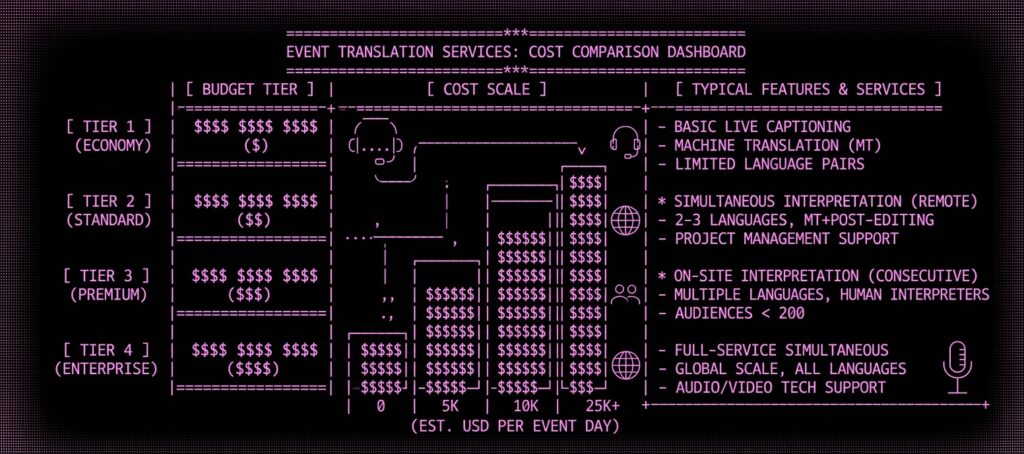
German interpretation pricing follows European market norms, which are structured differently from the US. German interpreters quote day rates (Tagessatz), not hourly rates, and the BDU (Bundesverband der Dolmetscher und Ubersetzer, Germany’s Federal Association of Interpreters and Translators) publishes recommended minimums that most professionals follow.
Human Interpreters: European Rates
Simultaneous interpretation requires two interpreters per language pair, rotating every 20-30 minutes. This is a non-negotiable industry standard per AIIC (International Association of Conference Interpreters) and is enforced even more rigorously in the German market.
- Interpreter full-day rate (up to 8 hrs): EUR 750-EUR 1,200/day each ($815-$1,300). German-English is well-supplied; technical specializations cost more.
- Interpreter half-day rate (up to 4 hrs): EUR 450-EUR 700/day each ($490-$760). Most agencies enforce half-day minimums.
- Mini-conference / remote (under 4 hrs): EUR 300-EUR 500 each ($325-$545). RSI platforms only; no booth needed.
- Interpretation booth rental: EUR 800-EUR 2,000/day ($870-$2,175). ISO 4043-compliant booths required at German venues.
- Wireless receivers (per unit): EUR 5-EUR 15/unit/day ($5.50-$16). Budget for 10-15% buffer above headcount.
- Sound technician: EUR 400-EUR 800/day ($435-$870). Most German venues require certified AV techs.
- Travel and per diem: EUR 200-EUR 500/day ($220-$545). Lower if event is in Frankfurt, Berlin, or Munich (large interpreter pools).
Sources: BDU rate guidance (2025), Konferenzdolmetscherin Claudia Schaffert published rates, OVS Translations, AIIC rate recommendations
Key difference from the US market: German interpreters expect preparation time to be compensated. If your event has 200 pages of technical documentation, the interpreters will bill 1-2 additional prep days at 50-75% of the day rate. Budget for this: it is standard practice in the DACH region and directly improves output quality.
AI Platform Rates
- Per-hour rate: EUR 50-EUR 180/hr ($55-$195). Wordly starts at ~EUR 70/hr for 10-hour packages.
- Per-event flat rate: EUR 450-EUR 2,800 ($490-$3,050). Some platforms price per event, not per hour.
- Per-attendee rate (RSI hybrid): EUR 2-EUR 12/attendee ($2-$13). KUDO, Interprefy use this model for large events.
- Equipment: EUR 0. Attendees scan a QR code on their phone.
- Operator/technician: EUR 0-EUR 400 ($0-$435). Most AI platforms run autonomously.
Side-by-Side: Your Event, Your Cost
| Event Scenario | Human Interpreters | AI Platform | Hybrid |
|---|---|---|---|
| Half-day board meeting (30 people, DE-EN only) | EUR 2,200-EUR 3,500 ($2,400-$3,800) | EUR 200-EUR 500 ($220-$545) | Overkill for this size |
| 2-day trade fair side conference (300 people, DE-EN, 8 sessions) | EUR 5,500-EUR 11,000 ($6,000-$12,000) | EUR 700-EUR 1,800 ($760-$1,960) | EUR 3,500-EUR 6,500 ($3,800-$7,100) |
| Hannover Messe satellite event (500 people, DE-EN-ZH, 3 days) | EUR 22,000-EUR 45,000 ($24,000-$49,000) | EUR 1,800-EUR 5,000 ($1,960-$5,450) | EUR 10,000-EUR 18,000 ($10,900-$19,600) |
| International medical congress (1,500 people, 4 languages, 5 days, 30+ sessions) | EUR 55,000-EUR 110,000 ($60,000-$120,000) | EUR 3,500-EUR 9,000 ($3,800-$9,800) | EUR 18,000-EUR 30,000 ($19,600-$32,700) |
| MEDICA-scale trade show (5 days, 5,000+ attendees, exhibit floor + stages) | EUR 35,000-EUR 70,000 ($38,000-$76,000), and you still cannot cover the exhibit floor | EUR 3,000-EUR 8,000 ($3,270-$8,700) | EUR 15,000-EUR 28,000 ($16,350-$30,500) |
The inflection point for German events: At a single DE-EN language pair for a single-track event, human interpreters deliver unmatched quality, especially for Germany’s precision-oriented business culture. The moment you add a third language or a second concurrent track, AI becomes 5-10x cheaper and the only way to cover every session.
Will AI Actually Handle German? An Honest Accuracy Breakdown
German is not Spanish. English-Spanish is AI translation’s best-performing language pair because of shared Latin roots and similar sentence structure. English-German is harder, and the reasons matter for your event.
Why German Is Challenging for AI
Compound nouns (Komposita). German builds meaning by combining words. Donaudampfschifffahrtsgesellschaft (Danube steamship company) is the famous example, but everyday conference German is full of compounds: Nachhaltigkeitsstrategie (sustainability strategy), Lieferkettenrisikomanagement (supply chain risk management), Datenschutzgrundverordnung (General Data Protection Regulation). AI systems must decompose these compounds correctly or the translation breaks. Google Translate achieved 94.56% overall accuracy for German (Kylian AI, 2025), but that average masks significantly lower performance on technical compound-heavy text.
Verb-final word order. In German subordinate clauses, the verb goes to the end. For simultaneous interpretation, human or AI, the system cannot begin translating the clause’s meaning until the final word is spoken. Human interpreters use anticipation and contextual inference. AI systems buffer and sometimes guess wrong.
Gendered nouns and case system. German has three genders and four grammatical cases that change article and adjective endings. Misgendering a noun or selecting the wrong case does not change meaning, a German audience will still understand, but it signals low quality and erodes trust in professional contexts.
Text expansion. German text runs 20-35% longer than equivalent English text (Transifex, 2025). This matters for live captioning and subtitle display: lines overflow, timing drifts, and attendees lose their place.
Accuracy by Session Type
- Keynote, clear speaker, prepared text, general vocabulary: AI 88-93% (DE to EN), 85-90% (EN to DE). Human 98-99%. AI viable for large audiences; human for C-suite or political speakers.
- Panel discussion, multiple speakers, crosstalk, informal register: AI 75-85% (DE to EN), 70-82% (EN to DE). Human 95-97%. Human strongly preferred; AI struggles with speaker transitions.
- Technical presentation, engineering/pharma/legal vocabulary, compound-heavy: AI 72-82% (DE to EN), 68-78% (EN to DE). Human 96-99% (with specialist interpreter). Human required; AI mishandles compound technical terms.
- Workshop / Q&A, rapid dialogue, audience questions from floor mics: AI 70-80% (DE to EN), 65-75% (EN to DE). Human 93-96%. Human preferred; AI has latency and floor-mic audio issues.
- Networking / exhibit floor, ambient noise, fragmented conversation: AI 55-70% (DE to EN), 50-65% (EN to DE). Human not applicable (no interpreter coverage). AI is the only option here, and it is better than nothing.
- Pre-recorded content, studio quality audio, single speaker: AI 92-96% (DE to EN), 90-94% (EN to DE). Human 99%. AI excellent; cost advantage is massive.
Sources: DeepL accuracy benchmarks (2025), Google Translate German evaluation (Kylian AI, 2025), KUDO AI accuracy data (2025), Taia translation quality report (2025)
Bottom line: For a general-audience keynote in a good acoustic environment, AI delivers solid German translation. For a technical breakout session on Lieferkettenrisikomanagement at a supply chain conference in Hamburg, AI will stumble on the exact terms that matter most to your audience.
Platform Comparison: Who Does What for German Events
- Wordly: German supported, AI only. Per-hour packages starting ~$75/hr. Standard NMT for compound word handling, adequate for general use. No dialect differentiation. Transcript + recording post-event. Attendee phones via QR code.
- KUDO: German supported, AI + human interpreter marketplace. Hybrid pricing (platform fee + interpreter hourly). Human interpreters handle compounds natively; AI assist varies. Austrian/Swiss German handled via human interpreter selection. Best for high-stakes events mixing human + AI.
- Interprefy: German supported, human interpreter network + AI assist. Custom quotes per interpreter hours + event size. Austrian/Swiss German via human interpreter selection. Government, corporate, diplomatic events. Transcript + recording.
- Snapsight: German supported, AI transcription + translation across 75+ languages. Event-based pricing; contact for quote. Contextual modeling for compound words. Processes Hochdeutsch; dialect variance handled at transcription level. Full transcripts, AI-generated summaries, cross-session synthesis, searchable content library. QR code access. Best for multi-day conferences where post-event content matters as much as live translation.
Where Snapsight Differs
Most interpretation platforms solve a single problem: getting Language A into Language B during a live session. Snapsight solves what happens after the session ends.
For a 3-day conference at Messe Frankfurt with 40 sessions across 6 parallel tracks, the live interpretation is only half the value. Snapsight captures every session in its source language, then delivers AI-generated summaries, searchable transcripts, and cross-session synthesis. An attendee who sat in the Industrie 4.0 track gets a briefing on what happened in the Nachhaltigkeit (sustainability) track. A marketing team back at headquarters gets a content library from the entire event, not a stack of recordings nobody will watch.
Snapsight’s scale: 10,415+ sessions transcribed across 627+ events in 75+ languages, operating at 91% autonomy. The German conference circuit’s specific demands (high-volume parallel sessions, technical vocabulary, and the post-event content pipeline that European event organizers increasingly expect) are exactly what the platform is built for.
10 Questions to Ask Any German Interpretation Vendor
- How do you handle German compound nouns in technical contexts? If they cannot explain their approach to Komposita, they have not thought about German specifically.
- Do you differentiate between Hochdeutsch, Austrian German, and Swiss German? Critical for DACH-wide events.
- What is your interpreter day rate, and does it include preparation time? German interpreters charge prep separately. Budget for it.
- Are your booths ISO 4043-compliant? German venue managers will ask. Some will refuse non-compliant setups.
- Can you staff specialized interpreters for my industry? Medical, legal, and engineering German have distinct terminologies.
- What happens if an interpreter cancels within 48 hours of the event? German events book out local interpreter pools quickly, especially during major trade fair weeks.
- Do you provide post-event transcripts and in what format? SRT, VTT, searchable text, or raw audio?
- How do you handle the verb-final word order in simultaneous interpretation? Tests whether the vendor understands German-specific interpretation challenges.
- What is your coverage for concurrent sessions? A 6-track conference at Messe Dusseldorf needs either 12 interpreters or an AI platform.
- Can you provide references from events at German venues (Messe Frankfurt, ICM Munich, CityCube Berlin)? Venue-specific experience matters for equipment compatibility and logistics.
Hidden Costs That Will Blow Your Budget
These are the line items that don’t appear on the first quote but show up on the final invoice.
- Preparation days: EUR 375-EUR 600 per interpreter per prep day (50-75% of day rate). Ask upfront; include in initial contract.
- Overtime beyond 8 hours: 150-200% of hourly rate for hours 9+. German labor law treats interpreter overtime seriously; schedule sessions to end on time.
- Equipment shipping to German venues: EUR 500-EUR 2,000 for booth logistics. Use venue-preferred AV partners. Most Messe venues have in-house equipment.
- Booth power and internet at Messe venues: EUR 300-EUR 1,500 depending on venue. German trade fair venues charge separately for power connections; confirm with venue management.
- Last-minute language additions: 200-300% premium if within 2 weeks. Lock language list 4+ weeks out.
- Rush transcript delivery: EUR 0.50-EUR 1.50 per minute of audio. Snapsight delivers AI transcripts in real-time; no rush fee.
- VAT (Mehrwertsteuer): 19% on all services in Germany (7.7% in Switzerland, 20% in Austria). Non-EU buyers can reclaim VAT but must file paperwork; factor into budget.
- Travel during trade fair weeks: Hotel rates in Hannover triple during Hannover Messe, in Dusseldorf during MEDICA. Book interpreter travel 3+ months early during major fair dates.
Decision Flowchart: What Does Your German Event Need?
How many language pairs do you need?
- 1 pair (DE-EN only), single-track, under 200 people: Human interpreters (EUR 2,200-EUR 4,000).
- 1 pair (DE-EN only), multi-track, 200-500 people: Hybrid. Human for plenaries, AI for breakouts.
- 1 pair (DE-EN only), 500+ people or 3+ concurrent tracks: AI platform. Cost-prohibitive for human coverage.
- 2-3 pairs (e.g., DE-EN-FR-ZH): AI or hybrid. Human for 4+ interpreters gets expensive fast.
- 4+ pairs: AI platform is the only scalable option.
Is the content highly technical (medical, legal, engineering)?
- Yes: Human interpreters for critical sessions + AI for parallel/secondary sessions.
- No: AI handles general business German well.
Do you need post-event content (transcripts, summaries, searchable library)?
- Yes: Snapsight. Post-event content is the core product.
- No: Any platform works for live-only interpretation.
Is this a recurring event (annual conference, quarterly summit)?
- Yes: Build a glossary with your vendor; accuracy improves over iterations.
- No: Standard setup.
Setup Timeline for German Events
German event culture values punctuality and thorough preparation. Plan accordingly.
- 12+ weeks out: Book interpreters for major trade fair periods. Hannover Messe (April), MEDICA (November), Frankfurt Book Fair (October), and IAA (September) drain the local interpreter pool. Book early or pay premiums.
- 8-10 weeks out: Confirm language pairs and session schedule. German interpreters expect detailed briefing materials; longer lead time means better prep.
- 6-8 weeks out: Equipment and booth logistics with venue. German Messe venues have strict technical requirements and preferred vendor lists.
- 4-6 weeks out: Share all presentation materials with interpreters. German interpreters will study your slide decks, white papers, and glossaries. This is standard practice and dramatically improves quality.
- 2-3 weeks out: Technical rehearsal (especially for hybrid/AI). Test audio routing, mic placement, and network bandwidth at the venue. German venues often have restricted WiFi policies.
- 1 week out: Final briefing call with interpreters or platform support. Confirm speaker pronunciations, company names, product names, acronyms.
- Day of: 90-minute sound check before doors open. Not 30 minutes, 90. German events start on time. If interpretation is not working at 09:00, you have a problem.
German Dialect Guide: Hochdeutsch, Austrian German and Swiss German
The DACH region shares a language but not a dialect. This matters for your interpretation setup.
- Hochdeutsch (Standard German): Used in all formal/business settings across Germany. The standard; what interpreters are trained in. Default for all interpretation. No special accommodation needed.
- Bavarian German (Bairisch): Bavaria (Munich, Nuremberg), most of Austria. Systematic consonant softening, vowel broadening, distinct vocabulary. Austrian speakers at international conferences typically use near-Hochdeutsch. Only an issue if speakers use heavy dialect.
- Austrian German (Osterreichisches Deutsch): Austria (Vienna, Salzburg, Graz). ~80% Bavarian dialect base; unique vocabulary: Paradeiser (tomato), Erdapfel (potato), Janner (January). Interpreters comfortable with Hochdeutsch handle Austrian German. Flag Austrian-specific terminology in briefing documents.
- Swiss German (Schweizerdeutsch): German-speaking Switzerland (Zurich, Bern, Basel). Largely unintelligible to standard German speakers. Not a dialect but a dialect group (Alemannic). This is a genuine problem. Swiss speakers at international events usually switch to Hochdeutsch for presentations, but Q&A and networking may revert to Swiss German. Confirm with Swiss speakers in advance. AI systems do not handle Swiss German reliably.
- Regional dialects (Plattdeutsch, Sachsisch, Schwabisch): Northern Germany, Saxony, Swabia. Varying degrees of difference from Hochdeutsch. Rarely an issue at professional conferences, speakers code-switch to Hochdeutsch in formal settings.
Practical advice: For a DACH-wide event (attendees from Germany, Austria, and Switzerland), all formal interpretation should use Hochdeutsch. Brief your Swiss German speakers to present in Hochdeutsch. Provide interpreters with a DACH terminology glossary that maps Austrian and Swiss vocabulary to their Hochdeutsch equivalents.
Major German-Language Conferences Worth Knowing
If you are selling interpretation services to German event organizers, or planning a multilingual event alongside one of these, these are the events that define the DACH conference calendar.
| Event | Location | Timing | Scale | Why It Matters |
|---|---|---|---|---|
| Hannover Messe | Hanover | April (April 20-24, 2026) | 200,000+ visitors, 5,000+ exhibitors | World’s largest industrial technology fair |
| MEDICA | Dusseldorf | November (Nov 16-19, 2026) | 81,000+ visitors from 150+ countries | World’s largest medical trade fair |
| Frankfurt Book Fair | Frankfurt | October (Oct 7-11, 2026) | 180,000+ visitors | World’s largest book and publishing trade fair |
| IFA Berlin | Berlin | September | 245,000+ visitors | Europe’s leading consumer electronics trade show |
| IAA Transportation | Hanover | September (Sep 15-20, 2026) | 150,000+ visitors | World’s leading mobility fair |
| gamescom | Cologne | August (Aug 26-30, 2026) | 265,000+ visitors | World’s largest gaming trade fair |
| Electronica | Munich | Biennial (November) | 80,000+ visitors | World’s leading electronics trade fair |
| Munich Security Conference | Munich | February | 450+ senior leaders | High-profile political event; diplomatic interpretation |
These events draw interpreters from across Europe. During Hannover Messe week (late April) and MEDICA week (mid-November), the German interpreter pool is functionally sold out. Plan around these dates or book 12+ weeks early.
For a 3-day, single-language-pair (DE-EN) conference, budget EUR 5,500 to EUR 11,000 ($6,000 to $12,000) for two simultaneous interpreters including booth rental, receivers, and a sound technician. Add preparation fees of EUR 750 to EUR 1,200 per interpreter if the content is technical. For AI-only coverage of the same event: EUR 700 to EUR 1,800 ($760 to $1,960). A hybrid approach, human interpreters for keynotes and plenaries with AI for breakout sessions, typically runs EUR 3,500 to EUR 6,500 ($3,800 to $7,100).
Partially. Modern AI translation (DeepL, Google Translate) handles common compounds well, including Datenschutzgrundverordnung (GDPR), Krankenversicherung (health insurance), and Bundesministerium (federal ministry). But novel or industry-specific compounds, such as Wasserstofftankstelleninfrastruktur (hydrogen fueling station infrastructure), often trip up AI systems, which either fail to decompose them or translate components incorrectly. For technical conferences where precision matters, human interpreters remain essential for German compound-heavy content.
No, for formal conference settings. Standard Hochdeutsch interpreters serve all three audiences. Austrian German is close enough that any qualified German interpreter handles it without difficulty. Swiss German is the exception: if your Swiss speakers will present or participate in Q&A in Swiss German (rather than switching to Hochdeutsch), you need interpreters with Alemannic dialect experience. Confirm language expectations with Swiss speakers before the event.
Late April (Hannover Messe), mid-November (MEDICA), late September through early October (Frankfurt Book Fair + IAA overlap), and late August (gamescom). During these weeks, German interpreter availability in the host cities drops dramatically, and rates may increase 20-40%. If your event falls during these periods, book interpreters at least 12 weeks in advance.
Simultaneous for any event with more than 30 attendees or sessions longer than 20 minutes. German business presentations tend to be structured, detailed, and long. Consecutive interpretation doubles the session time, which Germans find inefficient. The exception: small executive meetings (under 15 people) where consecutive allows for more nuanced, back-and-forth discussion. For trade fair booth meetings, whispered interpretation (Flusterdolmetschen) is the standard approach in Germany.
Interpretation services in Germany are subject to 19% Mehrwertsteuer (VAT). Austria charges 20%, and Switzerland charges 7.7%. Non-EU buyers can reclaim German and Austrian VAT through a formal application process, but Swiss VAT follows separate rules. Always confirm whether quoted rates are netto (excluding VAT) or brutto (including VAT). German vendors typically quote netto prices, which catches international buyers off guard.
Traditional interpretation vendors deliver raw audio recordings and basic transcripts, if anything. Snapsight delivers real-time transcripts in the source language, live translation into 75+ languages, AI-generated session summaries, and a searchable content library that synthesizes insights across every session. For a multi-track German conference, this means your team gets a complete intelligence briefing from sessions they could not attend, not a stack of 4-hour recordings in German that nobody will review.