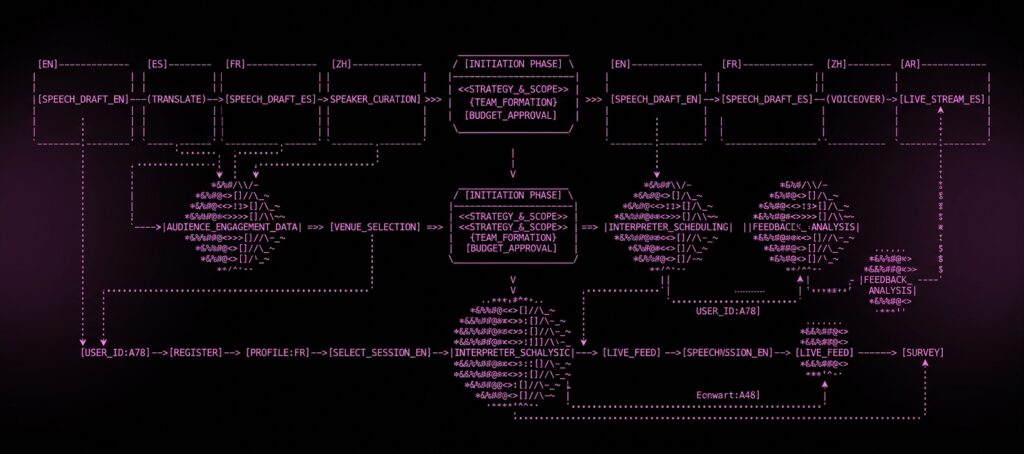
Real-time event intelligence is the capture, processing, and delivery of actionable insights from live event content as it happens, enabling organizers, attendees, and stakeholders to make informed decisions during the event rather than days or weeks afterward. It combines real-time transcription, live translation, instant summarization, and on-the-fly analysis to transform spoken content into structured intelligence with near-zero latency.
The “real-time” distinction is not a convenience. It is a strategic requirement.
Consider the difference between receiving a post-event summary on Monday morning and receiving an insight during the event itself. A post-event summary informs next time. A real-time insight informs right now. When the synthesis of three morning sessions reveals that attendees are converging on a specific challenge, the event organizer can add an afternoon discussion session to address it. When a keynote speaker references a statistic that contradicts the data in an upcoming breakout, the moderator can prepare a sharper question.
If your intelligence arrives after the event ends, you have analytics. If it arrives while the event is still running, you have intelligence.
The market is moving in this direction. The broader streaming analytics market is projected to reach $176 billion by 2032. In the event sector specifically, 46% of event tech budgets are now allocated to attendee engagement tools (up from 31% in 2024). AI analytics applied to live events can boost event ROI by up to 30%.
Understanding Real-Time Event Intelligence
What “Real-Time” Means in Practice
In event content intelligence, “real-time” has specific performance requirements.
- Transcription latency: 1-3 seconds from speech to text
- Translation latency: 3-8 seconds from source language to target language display
- Summary latency: Preliminary session summaries available within 5-10 minutes of session completion
- Cross-session intelligence latency: Theme detection and trend alerts within 15-30 minutes as patterns emerge
- Personalized delivery latency: Attendee-specific recommendations within minutes of the triggering content
The Three Dimensions of Real-Time Event Intelligence
Real-time event intelligence operates across three dimensions simultaneously.
- Dimension 1: Content intelligence. What is being said across sessions? What themes are emerging? What contradictions exist?
- Dimension 2: Behavioral intelligence. How are attendees engaging? Which sessions are over-capacity? Where are people moving?
- Dimension 3: Operational intelligence. How is the event technology performing? Are all audio feeds clean? Is transcription accuracy within acceptable ranges?
Most event technology platforms address one of these dimensions. Real-time event intelligence integrates all three, because decisions during a live event require understanding content, behavior, and operations simultaneously.
How Real-Time Event Intelligence Works
Architecture: Stream Processing
Real-time event intelligence requires stream processing, not batch processing. Content flows through a pipeline.
- Audio ingestion: Multiple concurrent audio streams captured from all event tracks simultaneously
- Real-time transcription: Speech converted to text with 1-3 second latency
- Immediate structuring: Text tagged with session metadata (speaker, track, time, language)
- Continuous analysis: As transcripts accumulate, analysis runs continuously: summarization updates, theme detection refreshes, alerts trigger when thresholds are met
- Real-time delivery: Outputs pushed to consumers (attendee apps, organizer dashboards, stakeholder feeds) as generated
This architecture is fundamentally different from “transcribe everything, then analyze.” The analysis begins with the first word spoken and continues throughout the event.
The Processing Pipeline
Each audio stream passes through multiple processing stages simultaneously.
- Stage 1: The autonomous operations layer joins the session, assesses audio quality, and begins capture
- Stage 2: Speech is converted to text in the source language with parallel translation streams for configured target languages
- Stage 3: The session intelligence engine extracts key insights, notable quotes, data points, and emerging themes
- Stage 4: Content feeds into the cross-session synthesis engine for pattern detection across all active sessions
- Stage 5: Structured outputs are delivered to their intended recipients through the appropriate channels
Delivery Channels
- Attendee mobile app: Personalized session recommendations, session summaries, and relevance alerts
- Organizer dashboard: Live view of emerging themes, session quality metrics, and operational status
- Executive feed: High-level synthesis updates delivered at configurable intervals
- Content team workspace: Structured content assets ready for real-time social media posting
- API integrations: Structured data feeds to event management platforms, CRM systems, and BI tools
Real-Time Event Intelligence in Practice: Examples
Example 1: Multi-Track Technology Conference
A technology company runs a 3-day user conference with 15 concurrent tracks and 180 sessions. The marketing team receives notable quotes within minutes for social media. The product team receives a live sentiment dashboard. The CEO receives an end-of-day brief 30 minutes after the final session, not three weeks later.
Example 2: International Summit with Time-Sensitive Content
An international trade organization hosts a summit with sessions in English, French, Spanish, and Arabic. Real-time event intelligence captures all sessions in all four languages and delivers cross-session synthesis identifying areas of emerging consensus and remaining disagreement. By the end of Day 1, delegation leaders have a structured brief informing Day 2 strategy.
Example 3: Medical Congress with Clinical Implications
A medical congress presents new research findings across 100 sessions. Real-time event intelligence detects when a session presents data that changes a clinical guideline, alerting interested attendees within minutes. Instead of discovering the finding in a post-event publication months later, clinicians can discuss it during the congress itself.
Why Real-Time Event Intelligence Matters
Content Velocity
A compelling statistic shared in a keynote is most valuable on social media within the first hour. Real-time intelligence captures content at peak relevance. AI-powered content features save marketers an estimated 13,000+ hours annually (Goldcast research).
Competitive Differentiation
An event that delivers real-time intelligence (personalized recaps, session recommendations, searchable content during the event) offers a qualitatively different experience from one that provides a PDF of speaker slides two weeks later.
Real-Time Event Intelligence vs. Real-Time Event Analytics
| Dimension | Real-Time Event Analytics | Real-Time Event Intelligence |
|---|---|---|
| What it processes | Behavioral data (check-ins, app clicks, booth visits) | Content data (what speakers said, what themes emerged) |
| Primary question | “What are attendees doing right now?” | “What are attendees learning right now?” |
| Key technology | Event app tracking, RFID, beacon sensors | Real-time transcription, NLP, LLMs |
| Actionable for | Logistics (room overflow, staffing) | Content (programming adjustments, attendee recommendations) |
| Market maturity | Established (most event platforms offer this) | Emerging (few platforms deliver this at scale) |
The distinction matters because both are valuable but serve different purposes. Real-time event analytics optimizes the physical event. Real-time event intelligence optimizes the intellectual event. The most sophisticated event operations use both.
The Future of Real-Time Event Intelligence
Conversational Intelligence Interfaces
Attendees will interact with event intelligence through natural language. “What has been said about sustainability today?” will return a synthesized answer drawing from all relevant sessions.
Ambient Intelligence
Event intelligence will become ambient, woven into the event experience. Attendees will receive contextual intelligence delivered to the right person at the right moment: a notification when a session across the hall covers a topic directly relevant to them.
Getting Started
Assess your latency requirements. Identify which decisions you need to make during the event versus after it. Most organizations benefit from a hybrid approach: real-time delivery for high-priority outputs and batch processing for deeper analysis.
Snapsight was architected for real-time event intelligence from the ground up. Its three AI agents, Operator, Analyst, and Insights, work in concert to capture content across 75+ languages, analyze it as it happens, and deliver personalized intelligence while the event is still running. With 627 events and 10,415 sessions processed, Snapsight is the most proven real-time event intelligence platform available. See real-time intelligence in action.
Live streaming delivers raw video and audio to remote viewers. Real-time event intelligence delivers structured, analyzed content: summaries, key insights, translated transcripts, theme reports, and personalized recommendations. Live streaming lets you watch a session remotely. Real-time event intelligence lets you understand what all sessions are producing simultaneously, even the ones you are not watching. They are complementary technologies, not alternatives.
The platform itself processes content in the cloud, so on-site bandwidth requirements are limited to audio upload from the venue. A single audio stream requires approximately 128-256 Kbps of upload bandwidth. A 15-track event would need roughly 2-4 Mbps of dedicated upload bandwidth for audio. This is well within the capacity of standard venue Wi-Fi, though dedicated upload bandwidth is recommended for events with more than 20 concurrent sessions.
Yes. Real-time intelligence is not limited to virtual or hybrid events. For in-person events, the audio capture typically connects to the venue’s AV system. The processing and analysis happens in the cloud, and outputs are delivered to attendees through a mobile app or event platform. In-person events actually benefit more from real-time intelligence than virtual events, because in-person attendees cannot easily switch between sessions and are more reliant on recommendations and summaries.
Costs depend on event size, number of languages, and depth of intelligence required. Typical pricing ranges from $100-$300 per session-hour for full real-time intelligence capabilities. A 50-session, 3-day conference typically costs $5,000-$15,000. This compares favorably to the cost of traditional post-event reporting (often $20,000-$50,000 for manual synthesis) while delivering results in real time rather than weeks later. Annual enterprise agreements can reduce per-event costs significantly.
No, but it transforms it. Instead of producing post-event reports from scratch (a process that typically takes 2-4 weeks), organizations that use real-time intelligence have structured data and pre-generated analyses available within hours of the event closing. Post-event reporting shifts from content creation to content curation: selecting, editing, and contextualizing the intelligence that was produced in real time. This cuts post-event reporting timelines from weeks to days while improving quality.