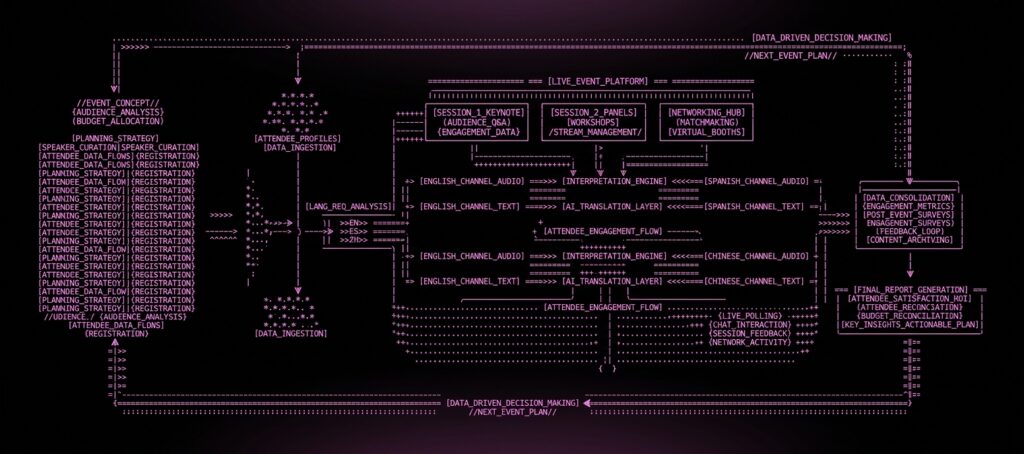
An event technology stack is the complete collection of software platforms, tools, and integrations that an organization uses to plan, promote, execute, and measure its events. Like the “marketing tech stack” or “sales tech stack” familiar in other business functions, the event tech stack represents the digital infrastructure that supports every phase of event production, from initial planning and registration through live execution, attendee engagement, content capture, and post-event analytics.
The global event technology market was valued at $21.7 billion in 2024 and is projected to reach $55.6 billion by 2032, growing at a CAGR of 12.5%, according to Congruence Market Insights. U.S. investment in event technology platforms alone surpassed $3.2 billion in 2024, with over 65% of large enterprise event budgets allocated to digital engagement tools and data analytics modules. Despite this spending, half of event professionals surveyed in 2025 said they were unsure about their technology spending levels, and only 22% were committed to investing more, according to PCMA’s 2025 Trends Report.
The core challenge: Most organizations have accumulated event technology through incremental additions rather than strategic design. The result is a patchwork of tools that do not integrate well, duplicate functionality, and create data silos. Understanding the event technology stack as a coherent system is the first step toward solving this problem.
Event Technology Stack Defined
An event technology stack is not a single product. It is an ecosystem of specialized tools that work together to support the event lifecycle. The stack typically spans six functional layers.
Planning and project management. Tools for timeline management, task assignment, budget tracking, venue sourcing, and team collaboration. Examples include Monday.com, Asana, and event-specific planning platforms.
Registration and ticketing. Platforms that handle attendee registration, payment processing, badge printing, and attendee data management. Examples include Cvent, Eventbrite, Bizzabo, and Swoogo.
Marketing and communication. Email marketing, social media management, event website builders, and attendee communication tools. Examples include HubSpot, Mailchimp, Splash, and platform-specific tools within Cvent or Bizzabo.
Live event execution. Tools used during the event: event apps, audience engagement platforms, live streaming, AV management, and on-site check-in. Examples include Swapcard, Whova, EventMobi, Slido, and streaming platforms like Vimeo or StreamYard.
Content capture and intelligence. Platforms that capture, transcribe, translate, and analyze session content in real time. This is the newest and fastest-growing layer of the stack, driven by AI capabilities that did not exist five years ago.
Analytics and measurement. Tools that measure event performance: attendance data, engagement metrics, lead capture, ROI calculation, and reporting. Often integrated into the registration platform or as standalone analytics tools.
How an Event Technology Stack Works
The value of thinking in “stack” terms rather than individual tools is integration. Each layer of the stack produces data that the other layers need.
Data Flow Example
- Registration platform collects attendee data: name, company, title, session selections, dietary needs, accessibility requirements.
- Marketing platform uses registration data to send personalized pre-event communications and session recommendations.
- Event app receives the attendee roster and session schedule, enabling personalized agendas, networking matching, and mobile check-in.
- Audience engagement tools (polling, Q&A) within the app capture real-time interaction data linked to individual attendee profiles.
- Content capture platform records, transcribes, and translates session content, linking it to the session schedule and attendee participation data.
- Analytics platform aggregates data from all layers to produce a unified view: which attendees attended which sessions, engaged with which content, asked which questions, and generated which leads.
When the Stack Works Well
An event organizer can answer: “Which sessions did our VIP attendees attend, how engaged were they, and what content themes emerged across those sessions?” This requires data flowing across registration, app engagement, and content capture layers.
When the Stack Is Fragmented
Each tool produces its own silo of data that requires manual export, reformatting, and stitching together, a process that can take weeks after the event.
Event Technology Stack for Events: Why It Matters
Operational efficiency
A well-integrated stack eliminates redundant data entry, manual reporting, and tool-switching during live events. When registration data flows automatically into the event app, which connects to the check-in system, which feeds the analytics dashboard, the operations team spends time managing the event rather than managing the technology.
Data-driven decisions
Fragmented tools produce fragmented data. An integrated stack creates a unified attendee journey: from registration behavior to session attendance to engagement levels to post-event actions. This connected data powers better decisions about programming, speaker selection, sponsor value, and budget allocation.
Attendee experience
From the attendee’s perspective, the stack should feel like one seamless experience. Register on the website, receive personalized communications, check in with the app, access session content, participate in polls, network with matched connections, and receive post-event materials, all without friction.
Cost management
Event technology spending is significant and growing. Understanding the stack as a system helps identify redundant tools, underutilized platforms, and integration gaps that waste budget. Many organizations discover they are paying for overlapping functionality across 3-4 tools when a single integrated platform could serve the purpose.
Components of a Modern Event Technology Stack
- Event management platform (core): The hub of the stack. Handles registration, agenda management, speaker management, and often serves as the integration point for other tools. Budget: $5,000-$50,000 per year. Major platforms: Cvent, Bizzabo, Swoogo, Splash.
- Event app and engagement: Mobile app for attendee-facing features: agenda, networking, maps, notifications, and session interaction. Budget: $2,000-$15,000 per event. Major platforms: Swapcard, Whova, EventMobi, Brella.
- Audience response and polling: Real-time polling, Q&A, and feedback collection during sessions. Budget: $200-$5,000 per event. Major platforms: Slido, Mentimeter, Poll Everywhere.
- Streaming and virtual event: For virtual and hybrid components: live streaming, virtual stages, breakout rooms. Budget: $1,000-$25,000 per event. Major platforms: Hopin, ON24, Vimeo, StreamYard.
- Content capture and intelligence: AI-powered transcription, translation, summarization, and content analysis. Budget: $1,000-$10,000 per event. This is the layer where Snapsight operates.
- CRM and marketing automation: Lead capture, attendee nurturing, and integration with sales workflows. Budget: Part of existing marketing stack (HubSpot, Salesforce, Marketo).
- Analytics and reporting: Unified dashboards combining data from all stack layers. Budget: $500-$5,000 per year for dedicated tools, or included in event platform.
Event Technology Stack Costs and Pricing
The total cost of an event tech stack varies dramatically by organization size and event complexity.
- Small organizations (1-5 events per year, under 500 attendees): $5,000-$20,000 per year. Often use a single platform (Eventbrite, Splash) supplemented with free tools (Google Forms, Canva).
- Mid-market (5-20 events per year, 500-5,000 attendees): $25,000-$100,000 per year. Typically use an event management platform plus 3-5 specialized tools for engagement, content, and analytics.
- Enterprise (20+ events per year, 5,000+ attendees per event): $100,000-$500,000+ per year. Full stack with enterprise platforms, custom integrations, and dedicated event technology staff.
The hidden cost is integration. Custom API integrations between platforms typically cost $5,000-$25,000 per integration. Organizations with 5-8 tools in their stack can spend $25,000-$100,000 on integration work, often exceeding the cost of the individual tools.
Event marketing represents an average of 14% of overall marketing budgets, with artificial intelligence leading technology adoption at 50% of event professionals planning to incorporate AI into their events in 2025.
How to Build an Event Technology Stack
Step 1: Audit your current tools
List every technology tool used across event planning, execution, and analysis. Include subscription costs, renewal dates, user counts, and which team members use each tool. Most organizations discover they are using 8-15 tools, many of which overlap.
Step 2: Map your data flow
Diagram how data moves (or does not move) between tools. Identify manual processes: where does someone export a CSV from one tool and upload it to another? These are integration gaps that waste time and introduce errors.
Step 3: Identify your core platform
Choose one platform as the hub of your stack. For most organizations, this is the event management platform (Cvent, Bizzabo, Swoogo). The hub should handle registration, agenda, and attendee data, and offer APIs or native integrations with other tools.
Step 4: Fill capability gaps
Identify what your core platform cannot do well, and select specialized tools to fill those gaps. Common gaps include advanced audience engagement, AI-powered content capture, and cross-event analytics.
Step 5: Prioritize integration
When selecting specialized tools, prioritize those with native integrations to your core platform. A slightly less feature-rich tool that integrates natively is often more valuable than a best-in-class tool that requires custom integration.
Event Technology Stack vs. Event Management Platform
Event Management Platform
A single product: Cvent, Bizzabo, or Swoogo. Handles core event functions like registration, agenda management, and basic reporting.
Event Technology Stack
The complete ecosystem of tools an organization uses for events. The event management platform is one component of the stack, typically the largest, but it does not cover every capability needed.
The common mistake is assuming that adopting a comprehensive event management platform eliminates the need for a stack strategy. In practice, even organizations using enterprise platforms like Cvent still use 4-8 additional tools for functions like audience engagement, content capture, design, project management, and specialized analytics.
Event Technology and the Role of AI
AI is restructuring the event technology stack by consolidating capabilities that previously required separate tools and by enabling entirely new functions.
Content intelligence is the clearest example. Before AI, capturing session content required hiring transcriptionists, translators, and content editors as post-production services. Now, platforms like Snapsight provide real-time transcription, translation across 75+ languages, summarization, and cross-session analysis as a single integrated layer. With 627+ events and 10,415+ sessions processed, Snapsight operates at 91% autonomy, meaning the content intelligence layer of the stack runs itself without requiring dedicated staff.
Predictive analytics uses historical event data to forecast attendance, optimize session scheduling, and recommend content. This capability is moving from standalone analytics tools into the core event management platform.
Personalization engines use attendee data to customize agendas, networking suggestions, and content recommendations. These are increasingly built into event apps rather than existing as separate tools.
The direction is clear: the event tech stack is consolidating. Fewer tools doing more, powered by AI, producing integrated data rather than siloed reports.
There is no ideal number, but most mid-market organizations operate effectively with 4-7 core tools. Below that, you are likely missing critical capabilities. Above 10, you are almost certainly dealing with redundant functionality and integration nightmares. The goal is not minimizing tool count but maximizing data flow. Five well-integrated tools outperform twelve disconnected ones.
The registration platform to event app integration is typically the most critical. This integration passes attendee data, session selections, and personalization preferences from the registration process to the live event experience. If this integration fails or is manual, every attendee’s first interaction with the event app requires re-entering information they already provided during registration, creating friction and frustration.
Ask three questions. First, how long does it take to produce a comprehensive post-event report? If the answer is more than one week, your data is too fragmented. Second, how many manual data transfers (CSV exports, copy-paste) happen between tools during event execution? Each one is a point of failure. Third, can you connect an individual attendee’s journey from registration through session attendance to post-event engagement? If not, your stack has data gaps that prevent meaningful analytics.
Both approaches have trade-offs. All-in-one platforms (Cvent, Bizzabo) offer built-in integration and a single vendor relationship, but may lack depth in specialized functions like content capture or advanced audience engagement. Best-of-breed approaches let you select the strongest tool for each function, but require integration work and multiple vendor relationships. Most organizations land on a hybrid: an all-in-one core platform supplemented by 2-4 specialized tools for capabilities where the core platform falls short.
AI is consolidating the stack by combining capabilities that previously required separate tools. Content capture, transcription, translation, summarization, and analysis used to require 3-5 separate services. AI-powered platforms now handle all of these in a single layer. AI is also reducing the human operational burden, meaning the stack requires fewer people to operate during live events. The most significant shift is from reactive to proactive: instead of analyzing data after the event, AI-powered tools surface insights during the event, enabling real-time adjustments to programming, attendee communications, and resource allocation.