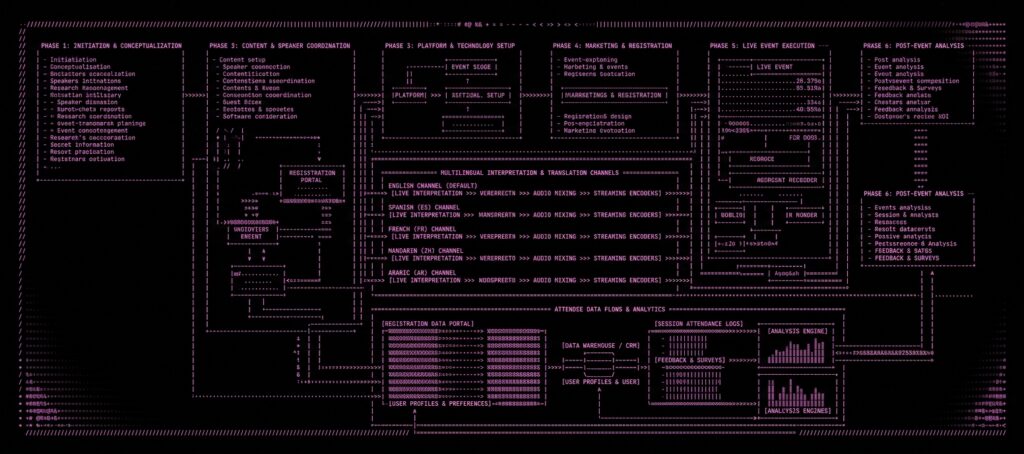
Event accessibility is the practice of designing, planning, and executing events so that all attendees, including people with physical, sensory, cognitive, and neurological disabilities, can fully participate in every aspect of the experience. It encompasses physical venue considerations like wheelchair ramps and accessible seating, digital accommodations like live captioning and screen-reader-compatible materials, and communication access like sign language interpretation and real-time translation.
For event professionals, accessibility is no longer a nice-to-have checkbox. It is a legal requirement, a reputational imperative, and an increasingly significant competitive advantage. An estimated 1.3 billion people worldwide experience significant disability, according to the World Health Organization, representing 16% of the global population. That is one in six potential attendees, speakers, sponsors, and exhibitors who will evaluate your event based on whether they can actually participate in it.
The Americans with Disabilities Act (ADA), the European Accessibility Act (EAA), and country-specific regulations each impose obligations on event organizers. Violations carry financial penalties, litigation risk, and lasting reputational damage. In the first half of 2025 alone, U.S. courts logged over 2,000 ADA accessibility lawsuits, a 37% increase compared to the same period in 2024.
This guide covers what event accessibility means in practice, the legal standards that apply, what it costs to implement, the technology that makes it scalable, and how to build accessibility into your event operations from the start.
Event Accessibility Defined
Event accessibility means removing barriers that prevent full participation. Those barriers fall into four categories.
Physical barriers include venue layouts that prevent wheelchair access, stages without ramps, seating configurations that isolate attendees with mobility devices, restrooms that do not accommodate wheelchairs, and parking lots without accessible spaces.
Sensory barriers include presentations without captioning for deaf or hard-of-hearing attendees, signage that is not readable by people with low vision, audio systems that do not support hearing loops or assistive listening devices, and video content without audio descriptions.
Cognitive barriers include overly complex registration processes, event apps that are not screen-reader compatible, information overload without clear wayfinding, and schedules without adequate break time for attendees with sensory processing differences.
Communication barriers include content delivered only in one language at multilingual events, materials not available in accessible formats like braille or large print, and the absence of sign language interpretation for deaf attendees.
True accessibility addresses all four categories simultaneously. An event with a wheelchair ramp but no captioning is only partially accessible.
How Event Accessibility Works
Accessible event planning follows a lifecycle approach. Accessibility is not a single deliverable added at the end. It is integrated into every phase of event production.
Pre-Event Planning
- Venue assessment. Conduct an accessibility audit of the venue before signing the contract. Check wheelchair access to all session rooms, restrooms, dining areas, and exhibit spaces. Verify elevator availability, accessible parking, and drop-off zones.
- Registration intake. Include accessibility questions on the registration form. Ask attendees to self-identify accommodation needs: captioning, sign language interpretation, assistive listening devices, dietary requirements, mobility assistance, service animal accommodations, or quiet rooms.
- Speaker preparation. Require speakers to submit materials in advance so they can be made accessible. Provide guidelines for accessible slide design: minimum 24-point fonts, high-contrast colors, alt text for images, and descriptive slide titles.
- Digital accessibility. Ensure the event website, registration platform, and event app meet WCAG 2.1 Level AA standards. This means keyboard navigability, screen-reader compatibility, sufficient color contrast, and text alternatives for non-text content.
During the Event
- Live captioning. Provide real-time captions for all general sessions and, ideally, breakout sessions. CART (Communication Access Realtime Translation) services typically cost $150-$300 per hour per captioner.
- Sign language interpretation. Book ASL interpreters or interpreters for the appropriate sign language for your audience. Two interpreters are required for sessions longer than 30 minutes so they can alternate.
- Assistive listening devices. Coordinate with the venue’s AV team to provide hearing loop systems or FM/infrared assistive listening devices.
- Quiet rooms. Designate a low-stimulation space for attendees who need sensory breaks.
- Accessible seating. Reserve front-row and aisle seats for attendees with mobility devices, interpreters, or captioning screens.
Post-Event
- Accessible content distribution. Share session recordings with captions, transcripts in accessible formats, and slides with alt text.
- Feedback collection. Ensure post-event surveys are accessible. Offer multiple response formats.
Event Accessibility for Events: Why It Matters
Legal compliance
The ADA requires that public accommodations, including conferences and events held in public venues, be accessible to people with disabilities. Title III applies to private entities operating places of public accommodation. Failure to comply can result in Department of Justice enforcement actions, lawsuits, and settlement costs that frequently exceed $50,000.
Starting April 24, 2026, updated ADA Title II regulations require public entities serving populations of 50,000 or more to ensure WCAG 2.1 Level AA compliance for web and video content, including live and recorded events. Smaller entities must comply by April 26, 2027.
The European Accessibility Act, effective June 2025, extends similar requirements across all EU member states.
Audience reach
People with disabilities control $1.2 trillion in annual disposable income globally. In the United States, 26% of adults have a disability, representing a $13 trillion market opportunity. Events that exclude this population lose speakers, attendees, sponsors, and the institutional knowledge they bring.
Reputation and brand
A 2025 survey by Level Access found that 94.8% of websites fail basic accessibility standards. Organizations that invest in accessibility stand out in a field where most competitors are failing. Accessible events generate positive word-of-mouth, media coverage, and repeat attendance from communities that actively share recommendations about inclusive experiences.
Types of Event Accessibility Accommodations
- Visual accommodations: Large-print materials, high-contrast signage, screen magnification, audio descriptions for video content, braille event programs
- Auditory accommodations: Live captioning (CART), hearing loop systems, FM assistive listening devices, sign language interpretation, visual alert systems
- Mobility accommodations: Wheelchair-accessible venues, ramps, elevators, accessible restrooms, reserved seating, lowered registration counters, accessible transportation
- Cognitive accommodations: Clear wayfinding, simplified event apps, quiet rooms, visual schedules, advance access to session materials, content warnings
- Digital accommodations: WCAG-compliant websites, screen-reader-compatible apps, keyboard-navigable platforms, captioned video content, accessible PDFs
- Communication accommodations: Real-time translation, multilingual captioning, plain-language materials, communication boards
Event Accessibility Costs and Pricing
Accessibility costs vary significantly based on event size, accommodation types, and whether services are in-person or virtual.
- CART captioning: $150-$300 per hour per captioner. A two-day conference with six session tracks running eight hours each could spend $14,400-$28,800 on captioning alone.
- ASL interpretation: $75-$200 per hour per interpreter, with a minimum of two interpreters per session. Two-day, single-track coverage runs approximately $2,400-$6,400.
- Assistive listening devices: $3-$10 per device per day rental, or $500-$2,000 for venue-installed hearing loop systems.
- Venue accessibility upgrades: Temporary ramps ($200-$1,000), portable accessible restrooms ($500-$1,500 per day), and accessible seating modifications ($500-$2,000).
- Digital accessibility auditing: $5,000-$25,000 for a comprehensive WCAG audit of event website and app, depending on complexity.
- AI-powered captioning and translation: $100-$300 per hour for AI-driven captioning platforms, with the advantage of scaling across multiple sessions simultaneously.
The cost of not being accessible is higher. ADA lawsuits averaged $25,000-$75,000 in settlements in 2024, and Department of Justice consent decrees can impose ongoing monitoring costs that run into six figures.
How to Choose an Event Accessibility Solution
When evaluating accessibility solutions and vendors, consider these criteria.
- Coverage breadth. Does the solution address physical, sensory, digital, and communication barriers, or only one category?
- Scalability. Can the solution support multiple concurrent sessions? A single CART captioner can only cover one session at a time, while AI captioning platforms can cover dozens simultaneously.
- Language support. For multilingual events, does the solution provide captioning and translation in attendees’ preferred languages?
- Accuracy. CART services achieve 98%+ accuracy. AI captioning has improved dramatically but varies by platform and audio quality. Evaluate accuracy claims with live demonstrations.
- Integration. Does the solution work with your existing event platform, streaming setup, and content management system?
- Compliance documentation. Can the vendor provide documentation that their solution meets ADA, WCAG, or EAA requirements? You may need this for legal compliance.
Questions to ask vendors:
- What specific standards does your solution comply with (WCAG 2.1 AA, Section 508, ADA)?
- What is your measured accuracy rate for live captioning in noisy environments?
- Can you scale across multiple simultaneous sessions?
- Do you provide post-event accessible content (transcripts, captioned recordings)?
- What is your contingency plan if the live service fails during a session?
Event Accessibility vs. Event Inclusion
Accessibility
Focuses on removing barriers. Ensures people with disabilities can physically and digitally access the event. Often driven by legal requirements with measurable standards (WCAG, ADA).
Inclusion
Broader in scope. Encompasses accessibility but also addresses representation, belonging, cultural sensitivity, gender equity, and socioeconomic access. An event can be technically accessible but not inclusive.
The most effective approach treats accessibility as the foundation and inclusion as the aspiration. Start with compliance, then build toward genuine belonging.
Event Accessibility and Event Technology
Technology is transforming event accessibility from a manual, expensive process into a scalable operation.
AI-powered captioning has reduced the cost of providing live captions from $150-$300 per hour (human CART) to a fraction of that cost, while covering unlimited concurrent sessions. Platforms like Snapsight provide real-time captioning across 75+ languages, making multilingual accessibility feasible for events that previously could only afford single-language accommodations.
Automated translation eliminates the language barrier that excludes non-English-speaking attendees. Instead of hiring separate interpreters for each language, AI translation platforms deliver real-time translated captions to every attendee’s device in their preferred language.
Accessible content distribution becomes automatic when sessions are captured, transcribed, and formatted for screen readers during the event. Post-event content is born accessible rather than retrofitted.
91% autonomous operation means accessibility technology runs without constant human management. Snapsight’s Operator Agent joins sessions automatically, monitors quality, and delivers accessible content, so event teams do not need to add accessibility coordination staff.
The shift from manual to AI-powered accessibility does not eliminate the need for human services. Sign language interpretation, personal assistance, and physical accommodations still require human providers. But technology dramatically expands what is feasible, particularly for organizations with limited accessibility budgets.
Yes, in most jurisdictions. In the United States, the ADA requires that events held in public accommodations be accessible to people with disabilities. Title III applies to most conference venues, hotels, and convention centers. The European Accessibility Act extends similar requirements across the EU as of June 2025. Many countries have equivalent legislation. Even events held in private venues may be subject to accessibility requirements if they are open to the public or receive government funding.
Costs range from minimal to substantial depending on your starting point and event complexity. Basic accommodations like accessible seating, large-print materials, and dietary options add 2-5% to an event budget. Adding live captioning, sign language interpretation, and assistive listening devices can add $5,000-$30,000 for a multi-day conference. AI-powered solutions are reducing these costs significantly, particularly for captioning and translation across multiple concurrent sessions.
Digital accessibility is the most frequently overlooked area. Event websites, registration platforms, and mobile apps often fail WCAG standards, preventing attendees who use screen readers or keyboard navigation from registering or accessing event information. Cognitive accessibility, including clear wayfinding, sensory break rooms, and advance access to materials, is also consistently underserved.
Include an open-ended accessibility question on your registration form. Ask: “Do you require any accommodations to fully participate in this event? If so, please describe what you need.” Provide specific examples (captioning, sign language, mobility access, dietary needs) to prompt responses, but keep the question open to capture needs you might not have anticipated. Follow up individually with anyone who requests accommodations to confirm details.
AI can supplement but not fully replace human accessibility services. AI captioning and translation have reached accuracy levels suitable for many event contexts, and they scale across unlimited sessions at lower cost than human providers. However, sign language interpretation requires human interpreters. Personal mobility assistance requires human staff. And high-stakes contexts like medical conferences or legal proceedings may still require human CART captioners for maximum accuracy. The most effective approach combines AI for scalable services with human providers for specialized needs.